
Location alone no longer counts
Until recently a centrally located building was a safe investment. Today, value increasingly depends on a building’s energy condition and how it is operated. ESG reporting requirements and taxonomies such as the CSRD and the EU Taxonomy, energy performance rules like the EPBD, and tightening carbon pricing turn weak operational models into real financial problems. Owners that only monitor instead of actively controlling risk worse financing terms, losing tenants and reduced investor interest.
Stranded assets: when operation destroys value
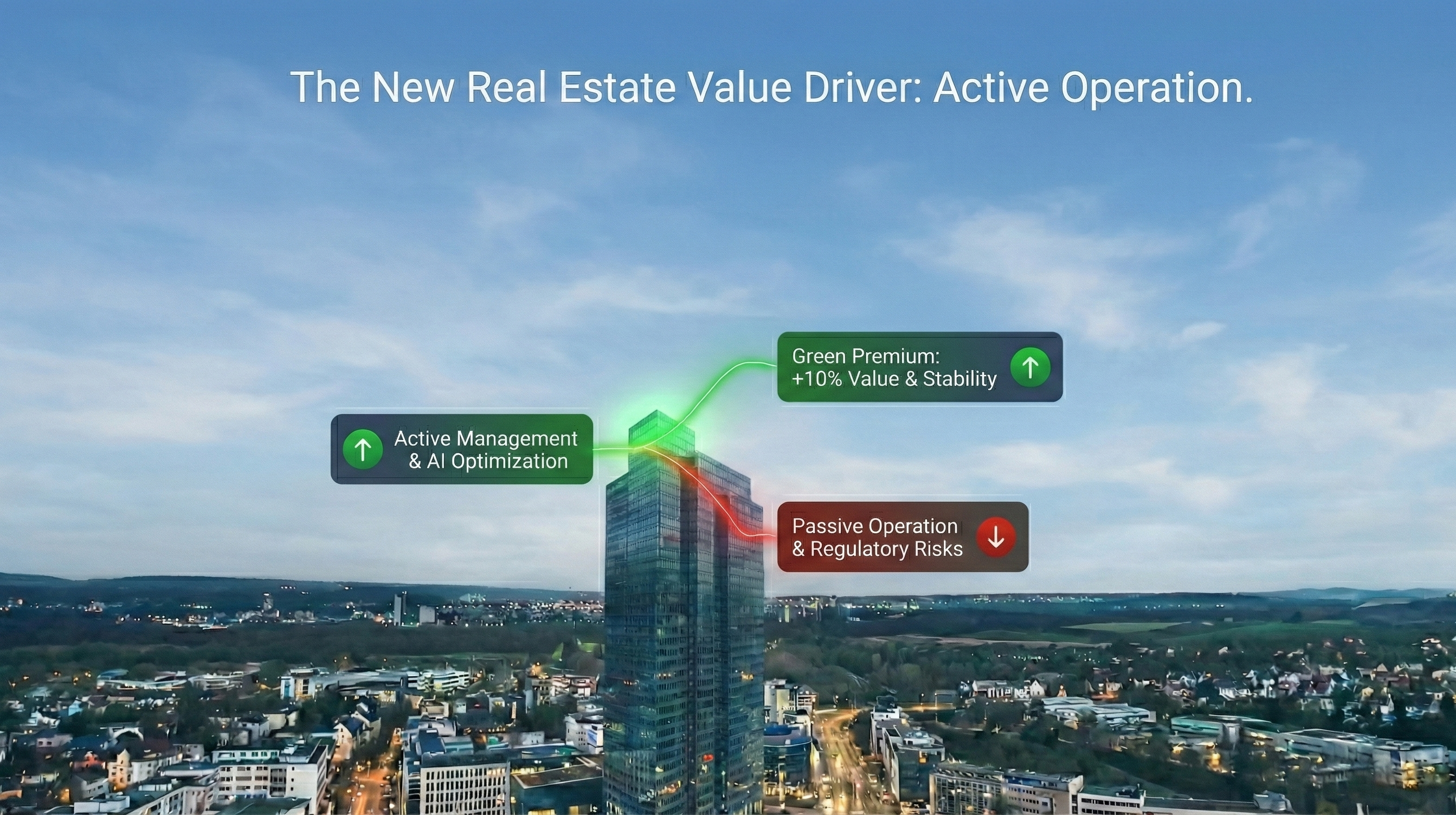
This dynamic creates stranded assets: buildings that are physically sound but economically impaired. Consider two nearly identical office buildings that start with the same market value. The passive asset, which ignores regulatory requirements and optimization, can lose 20 to 25 percent of its value in the coming years because of higher operating costs, tenant churn and tougher financing. The actively controlled asset, using AI-driven optimisation and automated compliance, instead captures a green premium of roughly 10 percent. That can mean a gap of more than €15 million between otherwise similar properties, simply because one was actively managed and the other was not.
Data as a control instrument, not a reporting task
Collecting data is not enough. Passive systems generate measurements; active systems turn them into rules, dynamic setpoints, optimization routines and KPI-driven decisions. Only operationalized data produces the audit trails and performance evidence required by modern ESG frameworks. Treating data as a control instrument improves energy performance, lowers emissions and directly strengthens refinancing prospects and investor confidence.
Automation eliminates hidden risks
Passive operating models are too slow for today’s regulatory and market dynamics. A single unnoticed inefficiency can trigger thousands in carbon costs or push a property across a compliance threshold that forces costly retrofits. Automated control corrects deviations in real time, flattens load peaks, stabilizes run times and exposes faulty controllers. What might otherwise become an unexpected CapEx shock turns into a manageable Opex issue and reduces the chance of regulators prescribing expensive emergency measures.
Act now to protect value
The real lever is operational, not always structural. AI-driven building automation can cut energy use and CO₂ emissions significantly, with practice showing reductions of up to around 30 percent, often without new sensors or disruptive construction. It delivers auditable ESG evidence and portfolio-scalable savings. Energy efficiency is becoming a core location factor, and active control is the strategic shield that preserves asset value, secures better financing, and keeps properties marketable for the long term.